
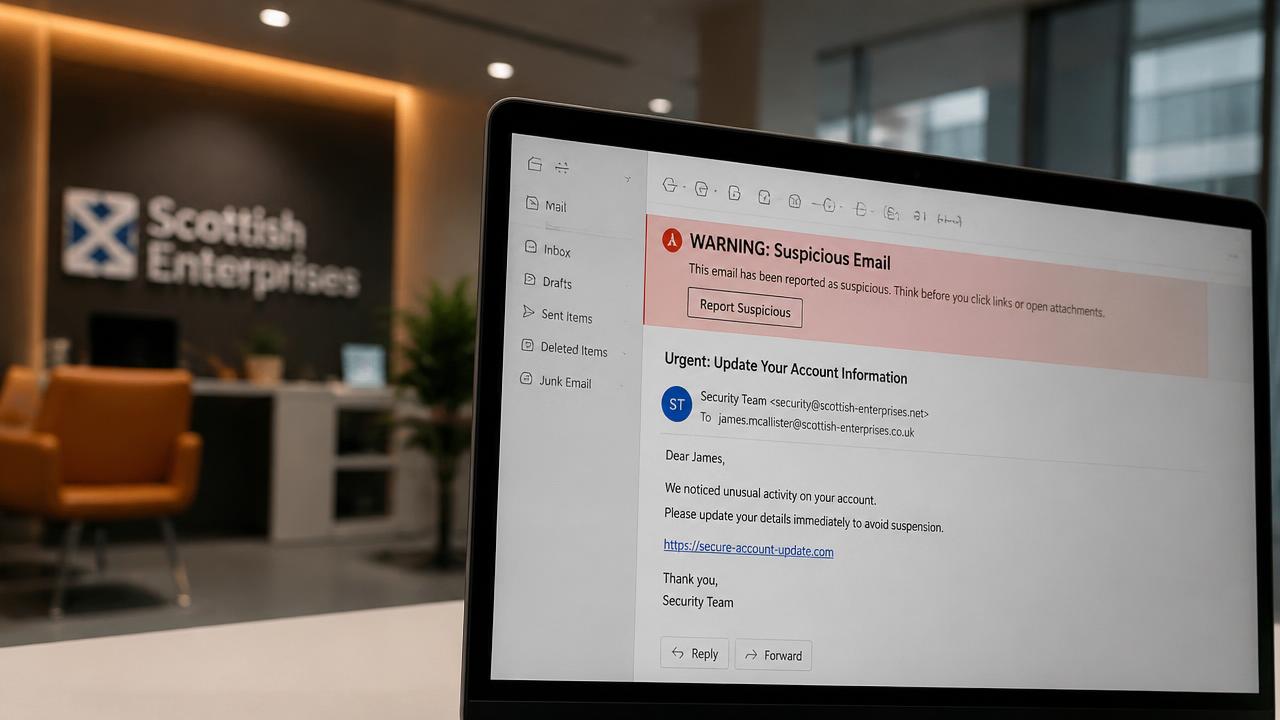
Phishing in 2026: Debunking the Scams Hitting Scottish Firms
Think phishing is still just poorly written emails? Discover the modern phishing tactics hitting Scottish businesses in 2026 and how to stay protected.
For many years, cybersecurity advice regarding phishing was relatively straightforward. Staff were told to look for poor spelling, awkward phrasing, suspicious sender addresses, and generic greetings such as "Dear Customer". If an email looked slightly unusual, you deleted it and moved on with your day.
In 2026, that traditional advice is not only outdated, it is actively dangerous.
Phishing has transformed into a sophisticated, multi-channel industry. Cybercriminals now use advanced artificial intelligence, compromised vendor accounts, and targeted social engineering to craft attacks that deceive even experienced professionals. From engineering firms in Dundee and manufacturing plants in Angus to financial services in Edinburgh and logistics hubs in Glasgow, Scottish businesses of every size are facing threats that look nothing like the scams of five years ago.
To help your team stay secure, we have broken down the five most dangerous phishing myths circulating today, alongside the practical steps needed to protect your organisation.
Myth 1: "Phishing emails are always full of spelling mistakes"
This is perhaps the most persistent misunderstanding in workplace security. In the past, attackers often operated from overseas without fluent English skills, leaving obvious grammatical errors in their text.
Today, generative artificial intelligence tools allow attackers to produce flawless, professionally written correspondence in seconds. A criminal can take a single public document from your website, feed it into an AI model, and generate an email that mirrors your company tone of voice, formatting, and industry terminology perfectly.
Furthermore, attackers now carry out detailed reconnaissance. They study company announcements on LinkedIn, review local press releases, and examine Companies House filings. When a fraudulent message arrives in an employee inbox, it often references genuine projects, real colleagues, and current business events happening in places like Perth or Fife. Relying on spelling checks as your primary line of defence is no longer viable.
Myth 2: "Phishing only happens inside the email inbox"
While email remains the primary vehicle for cyber attacks, phishing in 2026 has spread across multiple platforms and communication channels. Security professionals refer to this as multi-channel social engineering.
Modern campaigns frequently combine different tools to catch staff off guard:
- Quishing (QR code phishing): Attackers place QR codes inside PDF attachments or physical letters. Because security software cannot always read the URL hidden behind a QR code image, the message passes straight through email filters. When a worker scans the code with their mobile phone, they are taken to a fake login portal outside the corporate network defence perimeter.
- Collaboration platform attacks: As firms rely heavily on Microsoft Teams, Slack, and cloud sharing portals, criminals use stolen credentials to message staff directly inside these tools. Employees tend to trust internal chat messages far more than external emails.
- Vishing and voice cloning: Using short audio clips taken from public webinars, promotional videos, or phone calls, criminals can now clone the voice of a director or finance manager. A brief telephone call asking an employee to approve an urgent supplier payment can sound remarkably convincing.
- SMS and messaging apps: Phishing via text message or WhatsApp targeting mobile workers on site or on the road, often claiming to be an urgent IT system alert or banking notification.
If your security training only covers traditional email, your team remains vulnerable to everyday modern scams.
Myth 3: "Multi-factor authentication prevents all phishing attacks"
Multi-Factor Authentication (MFA) is essential. It is a mandatory requirement for frameworks like Cyber Essentials and remains one of the best technical controls you can implement. However, believing that standard MFA makes your business completely immune to phishing is a critical mistake.
Attackers have developed techniques specifically designed to bypass basic MFA setups:
- Adversary-in-the-Middle (AitM) phishing: When a user clicks a malicious link, they are directed to a proxy server controlled by the attacker, which mirrors the real login screen. The user enters their username, password, and MFA code. The proxy forwards these details to the genuine service, logs the user in, and simultaneously steals the active session cookie. The criminal can now access the account without needing the password or MFA token again.
- MFA fatigue attacks: Attackers obtain a stolen password and then flood the user with dozens of push notifications on their mobile phone late at night. Frustrated or confused, the employee eventually taps "Approve" just to stop the alerts.
Modern defence requires phishing-resistant authentication methods, such as FIDO2 hardware keys, conditional access policies that restrict logins to managed company devices, and continuous session monitoring.
Myth 4: "Small Scottish firms are too insignificant to be targeted"
Many business leaders across Scotland still believe that cybercriminals only target FTSE 100 corporations, major banks, or central government departments. In reality, small and medium-sized enterprises (SMEs) are targeted constantly precisely because their technical defences are often weaker.
Criminal groups do not spend months manually plotting against one small firm. Instead, they use automated scanning tools to test thousands of mailboxes and websites across Scotland simultaneously. If your domain has a vulnerability or an employee falls for an automated credential-harvesting campaign, your business becomes an immediate target of opportunity.
Moreover, small businesses are frequently used as stepping stones into larger supply chains. If you supply goods, maintenance, or professional services to larger organisations in Edinburgh, Glasgow, or local authorities across Angus and Fife, an attacker may compromise your email system simply to send legitimate-looking invoices to your high-value clients.
Under UK GDPR, you are legally responsible for safeguarding the personal data you hold, regardless of your company turnover. A breach originating from a small supply chain partner carries the same regulatory scrutiny and reputational damage as an internal failure.
Myth 5: "Our IT spam filter stops all dangerous messages from reaching staff"
Spam and malware filters are vital, but they cannot catch everything. In fact, many of the most damaging phishing attacks in 2026 do not contain malicious attachments, suspicious links, or known viruses.
Consider a classic Business Email Compromise (BEC) scenario. An attacker gains access to the genuine Microsoft 365 account of one of your existing suppliers. Because the email originates from the supplier's actual server, has valid security records (such as SPF, DKIM, and DMARC), and uses standard conversational language, spam filters see nothing wrong.
The attacker joins an ongoing email thread regarding an upcoming invoice and politely requests that payment be sent to an updated bank account. No technical filter can determine whether your supplier actually changed their bank account or if a criminal is pulling the strings. Only robust internal verification processes and trained staff can spot this kind of fraud.
How Scottish businesses can build practical resilience
Protecting your organisation against modern phishing does not require complex technical jargon or disruptive software. It requires a layered approach combining strong technology, sensible business processes, and well-supported staff.
- Enforce strong conditional access: Ensure that staff can only log into critical systems from approved, managed devices and expected geographical locations.
- Establish strict financial verification: Mandate that any request to change supplier bank details, payroll information, or large payment instructions must be verified via a known, trusted phone number, never using the contact details provided in the email itself.
- Run realistic, supportive training: Move away from annual tick-box tests. Provide regular, bite-sized training that exposes staff to modern attack vectors like QR codes and supplier invoice updates. Create a company culture where reporting a suspicious message, or admitting a mistake, is praised rather than punished.
- Align with Cyber Essentials: Achieving and maintaining Cyber Essentials certification ensures your core technical boundaries, access controls, and patch management processes meet recognised UK standards.
- Implement secure backup and recovery: If an account compromise does lead to data tampering or ransomware, ensure your business has immutable, cloud-based backups that allow you to restore operations quickly without paying a ransom.
The Orange Penguin Take
At Orange Penguin, we have been supporting and securing Scottish businesses from our Dundee base since 2007. Over the past nearly two decades, we have seen cyber threats shift from simple nuisance viruses to highly calculated social engineering campaigns.
Our philosophy has always been clear: cybersecurity should support your business growth, not slow it down. We do not believe in scaring business owners with technical jargon. Instead, we implement sensible, modern protections like phishing-resistant authentication, advanced cloud filtering, and clear operational policies that keep your team working smoothly and securely.
Whether your team is working from a single office or collaborating across multiple sites throughout Scotland, practical security is about building resilient layers that protect your balance sheet, your data, and your reputation.
Take the next step
Are you confident that your current email defences, cloud settings, and staff training could withstand modern phishing tactics?
Get in touch with the Orange Penguin team today to arrange a free, no-obligation IT health check. We will review your Microsoft 365 environment, assess your current security posture, and provide practical, straightforward recommendations to keep your business safe.
Written by Orange Penguin Team
Dundee based IT support, cybersecurity and cloud specialists, looking after ambitious Scottish businesses since 2007.